
What to do before, during, and after a freeze, and what to avoid
Texas freezes are unpredictable. The good news? Most freeze damage is preventable if you prepare correctly and don’t rush the restart. Here’s a clear, homeowner-friendly guide that covers all three phases.
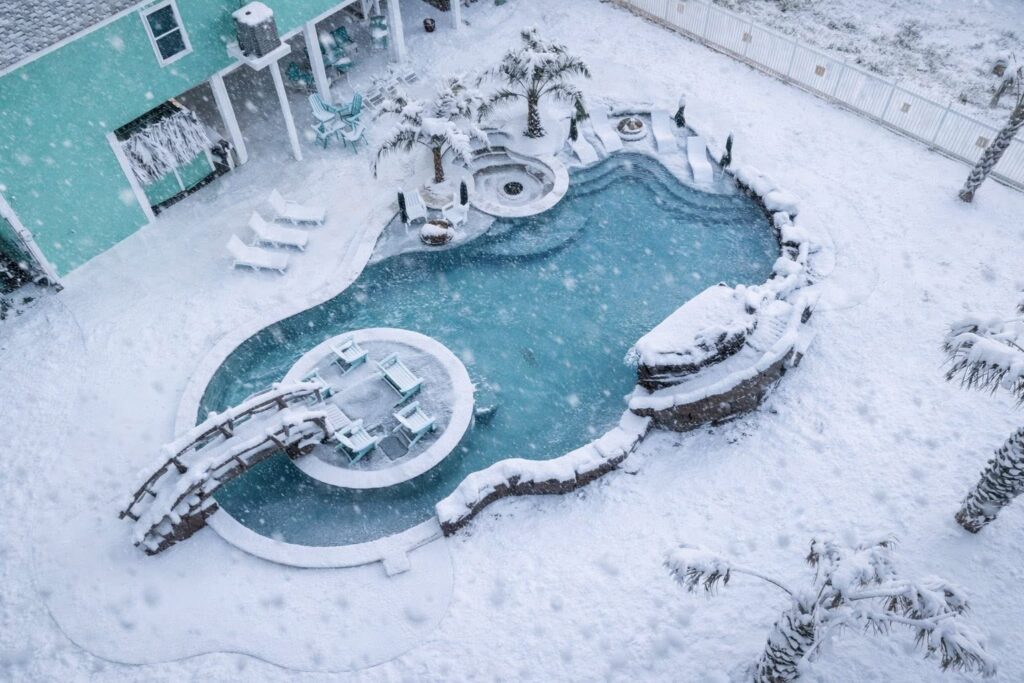


BEFORE A FREEZE: How to Prepare Your Pool
Preparation is the most important step. What you do before temperatures drop often determines whether you’ll have damage at all.
1) Keep the system running
If your pool has power and water, continuous circulation is your best defense. Moving water is far less likely to freeze.
2) Use freeze protection settings
If your system has freeze protection or automation, make sure it’s enabled and set correctly. Don’t assume it’s on—verify it.
3) Remove drain plugs – if circulation isn’t guaranteed
If there’s a chance of power loss, remove pump, filter, and heater drain plugs so water can escape instead of freezing inside.
4) Open valves and air reliefs – if circulation isn’t guaranteed
This helps prevent trapped water in plumbing and filter tanks.
5) Insulate exposed equipment and pipes – if circulation isn’t guaranteed
Use foam pipe covers, towels, or freeze blankets on exposed plumbing, pumps, and valves. Focus on the equipment pad.
6) Turn off and drain water features – if circulation isn’t guaranteed
Sheer descents, waterfalls, deck jets, and cleaners often freeze first.
WHAT TO AVOID BEFORE A FREEZE
- Don’t rely solely on “hoping it won’t get that cold”
- Don’t shut the system off without draining it
- Don’t forget about heaters and auxiliary plumbing
- Don’t wrap equipment so tightly that airflow is completely blocked while running
DURING A FREEZE: What to Do While It’s Cold
1) Let the pool run continuously
If temperatures are below freezing for several hours, avoid timers—run the system 24/7.
2) Visually check the equipment when possible
Look for ice buildup, unusual noises, or water spraying. If something looks wrong, shut it down and drain it.
3) Maintain power if safely possible
If you lose power, immediately drain exposed equipment once it’s safe to do so.
WHAT TO AVOID DURING A FREEZE
- Don’t turn equipment on and off repeatedly
- Don’t chip ice off equipment (this can crack housings)
- Don’t pour hot water on frozen equipment
- Don’t ignore strange noises or leaks
AFTER A FREEZE: How to Restart Safely
This is where many homeowners accidentally cause damage.
1) Wait for consistent above-freezing temperatures
Make sure overnight lows are safely above 32°F before restarting anything.
2) Do a full visual inspection first
Check pumps, filters, heaters, valves, unions, and exposed pipes for cracks, bulging, misalignment, or water on the pad.
3) Prime the pump slowly
Fill the pump basket with water and start the system briefly. Watch closely for leaks or pressure spikes.
4) Listen carefully
Grinding, whining, rattling, or rapid pressure changes can indicate freeze damage.
5) Inspect the heater closely
Heaters are one of the most common freeze casualties. Even a small leak can worsen once heat is applied.
6) Test and rebalance water chemistry
Freezes can throw off pH and sanitizer levels. Balance the water before running long cycles.
WHAT TO AVOID AFTER A FREEZE
- Don’t “just turn it on and see what happens”
- Don’t ignore small drips or damp areas
- Don’t run the heater until you’re sure there are no leaks
- Don’t assume damage would be obvious immediately
When to Call a Professional
Get a professional inspection if you notice:
- The pump won’t prime or loses prime
- Water collecting under equipment
- A dropping water level with no visible pool leak
- Heater leaks or failure to fire
- Air bubbles returning to the pool
- When you can see a water leak
Freeze damage often starts small and gets worse. Catching it early can mean a minor repair instead of full equipment replacement.
Final Takeaway
Freeze damage in Texas is rarely about how cold it gets—it’s about preparation and patience.
Prepare early, let the system run when needed, and restart slowly and carefully.
If you’re unsure whether your pool is safe to run after a freeze, it’s better to pause and check than to guess.