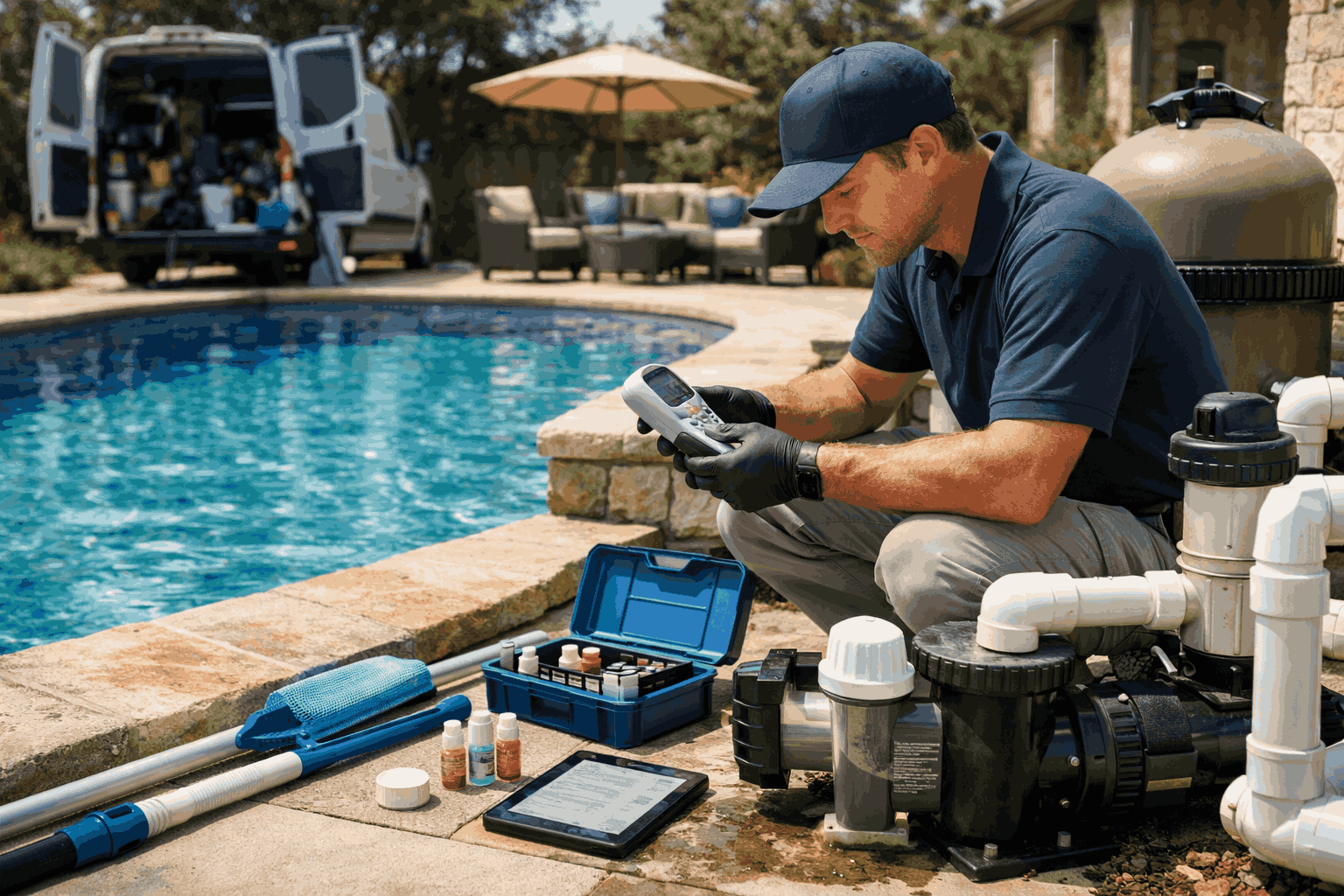
Your pool water test results are basically a report card for your pool — but most homeowners stare at the numbers and have no idea what they’re looking at. Whether you tested with strips, a liquid kit, or got a printout from the pool store, each number tells you something specific about your water’s health. The problem is that understanding pool water test data requires context, and context in DFW is different from the national averages printed on the back of the bottle. Here’s what do pool test numbers mean in plain language with North Texas–specific targets for every parameter that matters.
The Numbers That Matter in Your Pool Water Test Results

Free chlorine (FC). This is your active sanitizer — the chlorine that’s actually available to kill bacteria and algae right now. DFW target: 2 to 4 ppm for chlorine pools, 1 to 3 ppm for salt water. Below 1 ppm and your pool is essentially unprotected. Above 5 ppm can irritate skin and eyes. DFW note: chlorine burns off 30 to 50% faster here than in cooler climates because of our heat and UV intensity. Test frequently in summer. The CDC’s healthy swimming guidelines recommend maintaining at least 1 ppm free chlorine at all times for safe recreational water. Our chlorine shock guide covers what to do when FC crashes.
pH. Measures how acidic or alkaline the water is. DFW target: 7.2 to 7.6, with 7.4 being ideal. Below 7.2 and the water corrodes equipment, etches plaster, and irritates eyes. Above 7.8 and chlorine effectiveness drops dramatically, calcium precipitates out causing cloudy water and scale, and the water looks dull. DFW note: pH in North Texas always drifts high. You’ll use muriatic acid frequently, especially with salt systems. Our water chemistry guide covers the balancing process in detail.
Total alkalinity (TA). This is your pH buffer — it determines how stable your pH stays between adjustments. DFW target: 80 to 120 ppm. Below 60 ppm and pH bounces wildly. Above 150 ppm and pH locks in high, resisting acid corrections. DFW tap water often arrives at 100 to 200+ ppm TA, so you may need to lower it from the very first fill. Always adjust TA first, then fine-tune pH.
Calcium hardness (CH). The amount of dissolved calcium in your water. DFW target: 200 to 400 ppm. Below 150 ppm and the water gets aggressive, pulling calcium out of plaster surfaces and etching them. Above 400 ppm and calcium deposits coat everything — tile, equipment, surfaces, salt cells. This is the number one chemistry challenge in North Texas because our tap water already arrives at 150 to 300+ ppm. The Water Quality Association confirms that DFW’s water hardness ranks among the highest in the country. Critical rule: never add calcium hardness increaser in DFW unless a professional specifically tells you to.
Cyanuric acid (CYA). Your chlorine’s sunscreen. CYA protects chlorine from UV destruction. DFW target: 30 to 50 ppm for chlorine pools, 70 to 80 ppm for salt water. Below 20 ppm and Texas sun burns off all your chlorine in 2 to 3 hours. Above 80 to 100 ppm and you get chlorine lock — chlorine is present in your pool water test results but can’t actually sanitize. CYA only goes up. The only way to lower it is to drain and refill.
Salt level (salt pools only). Target: 2,700 to 3,400 ppm depending on your generator model. Too low and the system can’t produce enough chlorine. Too high and it corrodes metal components. DFW rain dilutes salt fast — test after every significant rainfall. Our salt cell maintenance guide covers salt management.
Phosphates. Algae food. DFW target: below 300 ppb. Above 500 ppb and algae has a food source that makes it harder to control with chlorine alone. North Texas soil runoff, lawn fertilizers, and decaying organic material introduce phosphates constantly. Use a phosphate remover quarterly as preventive maintenance. According to the Pool & Hot Tub Alliance, phosphate management is increasingly recognized as a key component of algae prevention in warm-climate pools.
Total dissolved solids (TDS). Think of this as the age of your water. DFW target: below 2,000 to 3,000 ppm. Above 3,000 and chemistry gets harder to manage, water looks dull, and nothing responds the way it should. Hard water areas accumulate TDS faster. Plan for a partial drain and refill every 3 to 5 years to reset.
What to Do With Your Pool Water Test Results



Check free chlorine and pH first — these are your immediate safety and clarity indicators. If FC is low, add liquid chlorine for the fastest response. If pH is high, add muriatic acid — that’s the most common DFW adjustment. If pH won’t stay down, check alkalinity because high TA locks pH in place. If water is cloudy despite good FC and pH, look at calcium and filter performance. If chlorine demand feels bottomless, check CYA. If algae keeps coming back despite everything, check phosphates and circulation.
If nothing seems to work, get a professional comprehensive test including TDS and metals. According to HomeAdvisor’s pool data, pools with regular professional water testing have significantly fewer emergency chemistry problems than pools relying solely on home testing.
Common Testing Mistakes That Ruin Your Pool Water Test Results
Testing in direct sunlight throws off color readings on strips and liquid kits. Expired reagents and strips give false results — check dates before trusting the numbers. Testing right after adding chemicals is useless — wait at least 8 hours with the pump running for proper distribution. Sample at elbow depth, not the surface. Don’t confuse total chlorine with free chlorine — total includes used-up combined chlorine that isn’t protecting anything. And never trust your salt generator’s built-in salt reading without independent verification. Those sensors drift. The U.S. Department of Energy recommends professional-grade testing at least monthly alongside home testing for the most accurate understanding pool water test picture.
People Also Ask
What should my pool water test numbers be?
For DFW: free chlorine 2 to 4 ppm, pH 7.2 to 7.6, alkalinity 80 to 120 ppm, calcium hardness 200 to 400 ppm, CYA 30 to 50 ppm (chlorine) or 70 to 80 ppm (salt). Our water testing guide has the complete target ranges.
Why is my pool chlorine always low even though I add it?
Three likely causes: CYA is too high (chlorine lock), pump isn’t running enough hours for proper distribution, or water temperature is so high that chlorine burns off before it can accumulate. Test CYA first — that’s the most common culprit in DFW.
What is the most important pool test number?
Free chlorine and pH are the two most critical. Chlorine keeps the water sanitized. pH determines whether chlorine can work effectively and whether the water is comfortable. Everything else matters, but those two come first every time.
How do I lower calcium hardness in my pool?
The only reliable method is dilution. Partially drain the pool and refill with fresh water. No chemical product effectively removes calcium from pool water. In DFW, managing calcium means keeping pH low (7.2 to 7.4) to prevent precipitation, not trying to remove the calcium itself.
Can I trust the free water test at the pool store?
Pool store tests are generally decent for the basics — chlorine, pH, alkalinity. But be cautious of product recommendations that follow. Some stores test to sell. An independent professional test from your service company gives you results paired with honest advice specific to your pool’s needs.
PoolBurg Reads and Acts on Your Pool Water Test Results Every Visit
Tired of guessing what do pool test numbers mean? Contact PoolBurg and we’ll handle professional-grade testing, instant interpretation, and precise chemical adjustment at every service visit. No guesswork, no confusion — just water that’s balanced right for DFW conditions.