A salt water pool isn’t chlorine-free. It just makes its own. A salt chlorine generator converts dissolved pool-grade salt into chlorine through electrolysis, producing a steady, low-level supply instead of the spikes and dips you get from manually adding tablets or liquid. The salt concentration sits around 3,000 to 3,400 ppm — roughly one-tenth the salinity of ocean water. You can barely taste it, your skin feels softer, and your eyes don’t burn after a long swim.
Saltwater pools have exploded in popularity across North Texas suburbs like Frisco, Southlake, and Prosper. Newer construction in these areas often comes with salt systems already installed. Homeowners love the lower chemical costs and smoother swimming experience. But salt water pool maintenance still requires real attention, especially in DFW where our hard water creates challenges you won’t find in other parts of the country.
Essential Salt Water Pool Maintenance Tasks
Testing and Maintaining Salt Levels
Your generator needs salt levels between 2,700 and 3,400 ppm to produce chlorine efficiently. Too low and the cell can’t generate enough sanitizer. Too high and you risk corrosion. Check monthly with a reliable test kit — don’t rely solely on your generator’s built-in readout, as those sensors drift over time.
Monitoring pH and Alkalinity
Salt pools naturally drift toward high pH — that’s just the nature of electrolysis. If you’re not testing weekly and adjusting with muriatic acid, your pH will creep above 7.8 and cause scale buildup, cloudy water, and reduced chlorine effectiveness. Keep pH between 7.2 and 7.6 and total alkalinity between 80 and 120 ppm.
Inspecting and Cleaning the Salt Cell
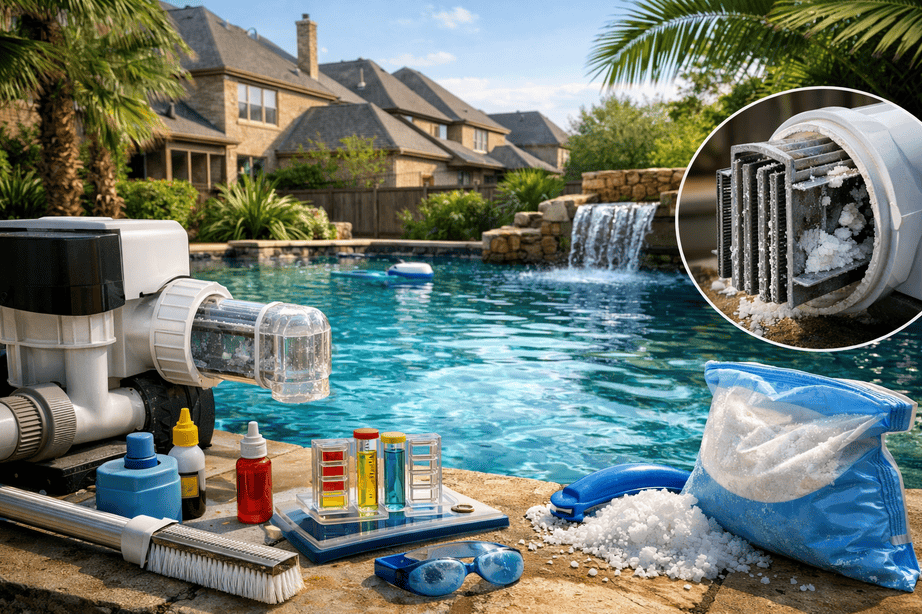
The salt cell is the heart of your system. Every three to four months, pull it out and inspect the plates for calcium scale. In North Texas, our hard water accelerates that buildup significantly. A mild acid soak — typically a 4:1 water-to-muriatic-acid solution — dissolves the deposits and restores efficiency. Skipping this step shortens cell life and reduces chlorine output.
Checking Calcium Hardness
This is where DFW pool owners run into the most trouble. Our tap water from the NTMWD system is naturally hard — loaded with calcium and magnesium from limestone-rich soil. In a salt pool, you want calcium hardness between 200 and 400 ppm. But our fill water often pushes past that threshold before you even add anything. High calcium means scale on your cell, tile line, and inside equipment. Managing it takes regular testing and often a scale inhibitor additive.
Stabilizer (Cyanuric Acid) Management
Cyanuric acid protects the chlorine your salt cell produces from UV destruction. In Texas, where intense sun runs from April through October, maintaining CYA between 70 and 80 ppm is essential. Without it, your generator works overtime trying to keep up with chlorine loss — which burns through the cell faster and drives up your electricity bill.
Common Salt Water Pool Problems in Texas

Scale Buildup From Hard DFW Water
Scale is the number one enemy of salt water pools in North Texas. That white, crusty buildup appears on your tile, inside pipes, and on salt cell plates — reducing flow, decreasing efficiency, and looking terrible. It’s a direct result of our high-calcium water and requires consistent management, not just a once-a-year scrub.
Salt Cell Corrosion and Lifespan Issues
A quality salt cell lasts three to seven years nationally. In Texas, that lifespan runs shorter — closer to three to five years — because cells work harder in the heat and hard water accelerates wear on the plates. Replacement cells run $400 to $800 depending on your system. Regular cleaning is the best way to get maximum life out of yours.
Algae Blooms in Extreme Heat
When water temperatures climb past 85 degrees — which happens routinely June through September — algae growth accelerates dramatically. If your salt cell can’t keep chlorine above 1 ppm during peak heat, you’ll wake up to a green pool. Many salt pool owners supplement with liquid chlorine during the hottest weeks or temporarily boost their generator’s output percentage.
Salt Water Pool Maintenance Schedule
Salt Water Pool Maintenance Cost in DFW
Salt and chemicals for a saltwater pool run $70 to $150 per year — significantly less than traditional chlorine at $300 to $500. But the real cost is the salt cell itself at $400 to $800 every three to five years. Professional weekly service runs $120 to $250 per month in DFW. DIY saves labor costs but still requires test kits, salt, acid, and occasional supplemental chlorine. All in, budget $1,200 to $2,500 annually for a well-maintained salt water pool in North Texas.
People Also Ask
Are salt water pools easier to maintain than chlorine pools?
In some ways, yes. You don’t need to buy, store, or handle chlorine — the generator produces it automatically. Day-to-day sanitizer levels stay more consistent. But salt pools still need regular testing, pH adjustment, cell inspection, and all the same physical cleaning. They’re not maintenance-free. They’re just different.
How often do you need to add salt to a saltwater pool?
Salt doesn’t evaporate or get consumed the way chlorine does. You mainly lose it through splash-out, backwashing, and rainwater dilution. Most DFW pool owners add salt once or twice per year. A 40-pound bag of pool-grade salt costs $6 to $15, and a typical pool needs four to eight bags per addition.
What is the lifespan of a salt cell in Texas?
Three to five years with proper maintenance is typical in North Texas. The combination of hard water, extreme heat, and long swim seasons wears cells faster than in milder climates. Regular cleaning and balanced water chemistry are the biggest factors in maximizing cell life.
Can hard water damage my salt water pool?
Absolutely. High calcium causes scale deposits on the salt cell plates, reducing chlorine production and shortening cell life. Scale also builds on tile, inside pipes, and on pool surfaces. In North Texas, hard water management isn’t optional — it’s one of the most critical parts of salt water pool maintenance.
Professional Salt Water Pool Maintenance by PoolBurg
PoolBurg specializes in salt water pool maintenance across North Texas. We understand the specific challenges DFW hard water creates for salt systems, and we adjust our approach accordingly — from cell cleaning schedules to calcium management strategies tailored to your neighborhood’s water profile. Whether you’re in Frisco, Southlake, Prosper, Plano, McKinney, or any of the 17 cities we serve, we keep your salt pool running efficiently year-round.
Book your saltwater pool inspection today.
Let us check your salt cell, chemistry, and equipment — before small issues become big bills.
Visit poolburg.com or call us today.