Salt chlorine generator maintenance is one of those things that separates DFW salt pool owners who spend $400 every three years on cells from the ones who spend $400 every five to seven years. The difference is maintenance — specifically, consistent salt cell cleaning and proper water chemistry management. North Texas hard water is brutal on salt cells. It coats the plates with calcium, reduces chlorine production, and shortens cell life dramatically if you’re not staying on top of it.
Whether you’re running a Pentair IntelliChlor, Hayward AquaRite, Jandy AquaPure, or any other system, this guide covers everything you need to know about keeping it running efficiently and avoiding premature salt cell replacement.
What Is a Salt Chlorine Generator and How Does It Work?
The concept is simple: salt water passes through an electrolytic cell with charged metal plates, and the electrical current converts dissolved salt into chlorine. No more buying, hauling, and adding chlorine manually — the generator makes it continuously. The system has four main components: the salt cell itself, a control board that manages output, a flow sensor that confirms water is moving, and a salinity sensor that monitors salt levels.
Common systems in DFW include the Pentair IntelliChlor, Hayward AquaRite, Jandy AquaPure, and CircuPool. Salt systems are popular in North Texas for good reason — convenience, softer-feeling water, and reduced chemical handling. But they need more attention here than in softer-water markets, and that’s where proper salt chlorine generator maintenance becomes critical.
Why Salt Cells Die Faster in North Texas
DFW Hard Water Is the Number One Enemy
This is the reality every DFW salt pool owner needs to understand. Every time water passes through your salt cell, calcium from DFW’s notoriously hard water deposits on the cell plates. That calcium scale reduces chlorine production efficiency and forces the cell to work harder. Nationally, salt cells average 5 to 7 years of life. In DFW hard water, 3 to 5 years is more realistic without aggressive salt chlorine generator maintenance. The calcium in our water literally eats through your investment faster than almost anywhere else in the country.
Over-Production Accelerates Wear
Running your generator at 100 percent output all summer is like redlining your car engine every day. It wears the cell plates faster and shortens lifespan. The fix is proper sizing and output calibration — your salt chlorine generator maintenance should include adjusting output percentage to match actual chlorine demand, not just cranking it to max and forgetting about it.
Poor Water Chemistry Compounds the Damage
High pH combined with high calcium creates the perfect storm for aggressive scale formation on cell plates. Low salt levels force the cell to overwork. And high CYA makes the chlorine output seem insufficient, which leads homeowners to crank up the generator even more. It’s a vicious cycle that accelerates cell death. Consistent chemistry management is a core part of IntelliChlor maintenance and every other salt system brand.
Salt Cell Cleaning — The Most Important Maintenance Task for DFW Salt Pool Owners
How Often to Clean Your Salt Cell in North Texas
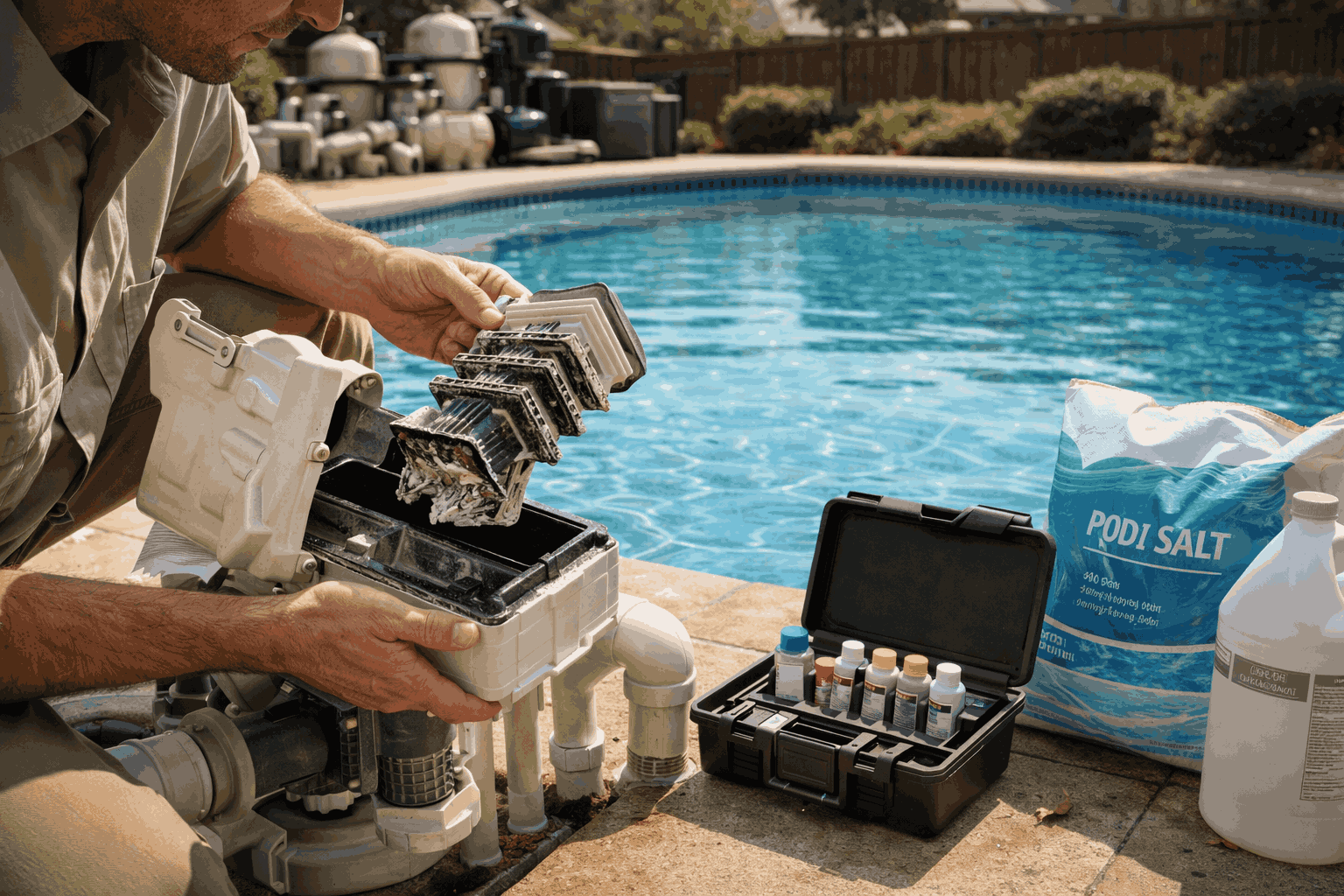
The national recommendation for salt cell cleaning is every three to six months. In DFW, forget six months — our hard water demands inspection monthly and cleaning every two to three months at minimum. Here’s a quick visual test: pull the cell out and hold it up to light. If you can’t see clearly through the plates, it needs cleaning. Don’t wait for error codes — by the time your control board alerts you, the scale has already done damage.
How to Clean a Salt Cell — Step by Step
Here’s the proper salt cell cleaning process.
Step 1: Turn off the system completely and remove the cell from the plumbing.
Step 2: Inspect the plates for white calcium buildup.
Step 3: Prepare a 4:1 water-to-muriatic acid solution in a plastic bucket — always add acid TO water, never the other way around.
Step 4: Submerge the cell in the acid solution for 5 to 15 minutes.
Step 5: Watch for bubbling — that’s the acid dissolving calcium deposits.
Step 6: Rinse thoroughly with a garden hose.
Step 7: Inspect the plates — repeat the soak if scale remains.
Step 8: Reinstall and verify the system is operating normally.
SAFETY WARNING: Acid cleaning produces fumes. Always do this outdoors in a well-ventilated area. Wear chemical-resistant gloves and eye protection. The CDC chemical safety guidelines stress proper handling of pool chemicals to prevent injury.
When Salt Cell Cleaning Is No Longer Enough
There comes a point where cleaning can’t restore a cell to adequate performance. If the plates are visibly thin or eroded, if you’re getting “Check Salt” or “Low Salt” alerts despite correct salt levels, if chlorine output drops even right after a fresh clean, or if the cell is four-plus years old in DFW hard water — it’s time for a salt cell replacement. No amount of acid soaking brings back metal that’s been eaten away.
Salt Cell Replacement — Cost and Options in DFW
Replacement Cost by Brand
Here’s what salt cell replacement costs in the DFW market. Pentair IntelliChlor IC40: $400 to $600. Pentair IntelliChlor IC20: $300 to $450. Hayward AquaRite T-Cell-15: $350 to $550. Hayward AquaRite T-Cell-9: $250 to $400. Jandy AquaPure Ei cell: $350 to $500. Generic aftermarket cells run $200 to $350 but come with shorter lifespans and mixed quality reviews. Professional installation labor adds $50 to $150.
OEM vs Aftermarket Cells — The DFW Verdict
In softer water markets, aftermarket cells can be a decent budget option. In DFW hard water, we recommend OEM cells every time. They’re built with thicker plates and better coatings that hold up longer against calcium scaling. An OEM cell that lasts five years in DFW costs less per year than an aftermarket cell that dies in two. The long-term salt cell replacement math favors quality over savings on the upfront price tag.
Salt Chlorine Generator Maintenance — Control Board Issues
Common Control Board Problems
Not every salt chlorine generator maintenance issue is the cell itself. Control boards develop their own problems: error codes that indicate sensor failures, flow sensor malfunctions that trigger false “no flow” errors, salinity sensor drift that gives incorrect salt readings, and power supply failures from Texas storm surges. Your pool automation system integration can also create communication issues between the generator and your main control panel.
Repair vs Replacement for Control Boards
Some control board issues are simple sensor replacements costing $50 to $150. A full control board replacement runs $200 to $500 depending on the brand. And when both the board and cell need replacing, a complete system swap runs $600 to $1,200. Your tech should diagnose the specific component before recommending the most cost-effective IntelliChlor maintenance or repair path.
Extending Your Salt Cell’s Life in North Texas
Here’s where proper salt chlorine generator maintenance really pays off. Clean the cell on schedule — every two to three months in DFW, no exceptions. Keep pH locked at 7.2 to 7.4 because lower pH reduces calcium precipitation on the plates. Don’t over-produce — set your generator output to match actual chlorine demand instead of running at maximum. Consider a pre-filter when adding fill water to reduce calcium input from the tap. Maintain proper salt levels at all times — running low stresses the cell and shortens its life. And if you’re shopping for a new system, consider one with reverse-polarity self-cleaning technology.
With disciplined maintenance, you can extend your salt cell’s life by one to two additional years in DFW conditions. On a $500 cell, that’s hundreds in savings. For more on salt water pool care in North Texas, check out our complete salt water pool maintenance guide.
People Also Ask
How often should I clean my salt cell in Texas?
In DFW, inspect monthly and perform a full salt cell cleaning every two to three months. Our hard water deposits calcium faster than the national average, so the standard three-to-six-month recommendation isn’t frequent enough here.
How much does a salt cell replacement cost?
Salt cell replacement in DFW ranges from $250 to $600 depending on your brand and model, plus $50 to $150 for professional installation. OEM cells cost more upfront but last longer in DFW hard water.
Why does my salt cell keep getting clogged?
DFW’s high calcium hard water is almost certainly the cause. Calcium deposits form on the cell plates every time water passes through. If your pH is running above 7.6, scale forms even faster. Regular salt cell cleaning and keeping pH at 7.2 to 7.4 are the best defenses.
How long should a salt cell last in North Texas?
Expect 3 to 5 years with regular salt chlorine generator maintenance in DFW hard water. Nationally, cells average 5 to 7 years, but our calcium levels shorten that timeline. Proper maintenance can push toward the higher end of that range.
Can I use vinegar instead of muriatic acid to clean my salt cell?
White vinegar works for light buildup but it’s not strong enough for the heavy calcium scale typical in DFW pools. Muriatic acid at a 4:1 dilution is the industry standard for effective salt cell cleaning in hard water markets. The Pool & Hot Tub Alliance recommends proper acid cleaning for calcium removal.
What does “Check Salt” mean on my chlorine generator?
It usually means one of three things: your salt level is actually low and needs replenishing, your salinity sensor has drifted and needs recalibration, or your salt cell is failing and can’t produce chlorine efficiently even at correct salt levels. Test your salt level independently first — if it’s correct and you still see the alert, it’s time for professional IntelliChlor maintenance or diagnostics on your specific system.
PoolBurg’s Salt System Service — Cell Cleaning, Replacement, and Optimization
At PoolBurg, salt chlorine generator maintenance is part of what we do across our entire DFW service area. We inspect salt cells at every service visit, include salt cell cleaning in our premium plans, and handle salt cell replacement with OEM parts when the time comes. We also optimize your generator output and water chemistry to squeeze every possible month of life out of your cell. Pentair IntelliChlor, Hayward AquaRite, Jandy AquaPure — we service them all.
Salt cell needs attention? PoolBurg inspects, cleans, and replaces — schedule salt system service today.