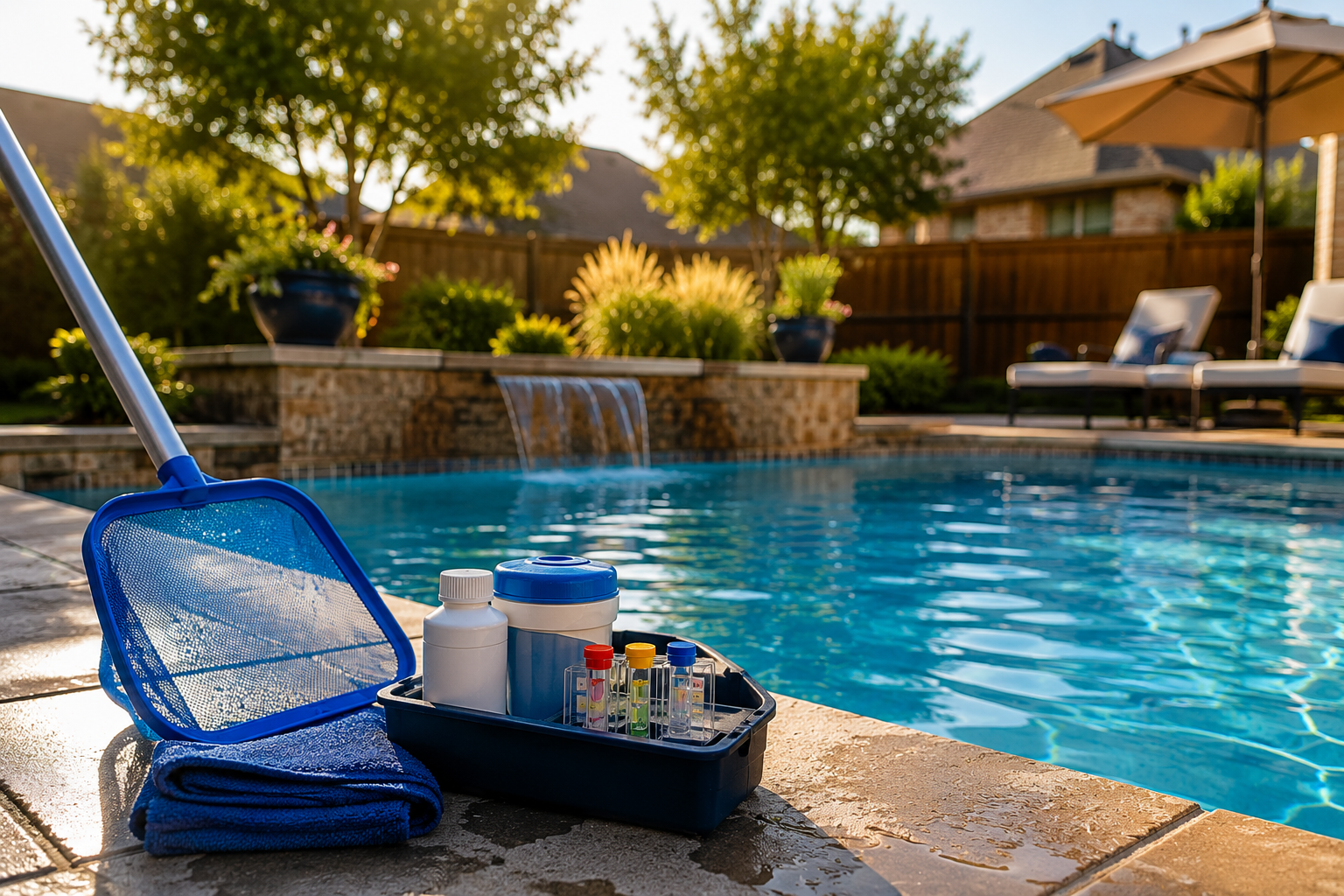
Pool chemical maintenance is the quiet little routine that decides whether your DFW pool looks like a resort or turns cloudy right before guests arrive. North Texas gives pool water everything at once: hot sun, hard source water, wind, pollen, sudden storms, and long swim seasons. The goal is simple: balanced, safe, crystal clear water without turning your garage into a confusing chemical warehouse.
Pool Chemical Maintenance Starts With Knowing What Each Chemical Does
A pool is basically a small outdoor water system. Sanitizer kills germs, pH controls comfort and chlorine strength, alkalinity helps stabilize pH, calcium affects scale and surface protection, and stabilizer protects chlorine from sunlight. The CDC recommends proper disinfectant and pH levels, and its home pool and hot tub water treatment guidance is a helpful baseline for homeowners who want safe water, not guesswork.PoolBurg sees this every week during weekly pool service calls across DFW. A pool may look fine on Monday and be dull by Thursday if sanitizer drops, the pump schedule is weak, or rain dilutes the chemistry.

Essential Pool Maintenance Chemicals for North Texas Pools
Chlorine is the primary sanitizer
Chlorine is still the workhorse of swimming pool chemical maintenance. Liquid chlorine, trichlor tablets, dichlor granular products, and cal-hypo shock all have a place, but they do not behave the same. In DFW, many pros lean on liquid chlorine because it sanitizes without constantly adding calcium or cyanuric acid. Tablets are convenient, but relying on them all season can lead to CYA creep.
pH and alkalinity keep the water comfortable
Most pools are happiest around the mid-7s for pH, and alkalinity acts like the guardrail that keeps pH from bouncing all over the place. Salt systems, water features, and high-alkalinity fill water can push pH upward, so muriatic acid is common in North Texas pool chemical maintenance.
Calcium hardness needs special attention in DFW
This is where local experience matters. Many DFW pools already receive mineral-heavy fill water, and the North Texas Municipal Water District explains that hard water build-up comes from naturally occurring minerals in local source water. That means homeowners should be careful before adding calcium hardness increaser. Too much calcium can create scale on tile, spillways, heaters, salt cells, and pool surfaces.
Cyanuric acid protects chlorine from the sun
Cyanuric acid, often called stabilizer or conditioner, helps outdoor pools hold chlorine under Texas UV. The catch is balance. Too little CYA and chlorine burns off quickly. Too much CYA and chlorine works more slowly. The Council for the Model Aquatic Health Code notes that CYA helps maintain free chlorine levels in outdoor pools, but it is not itself a disinfectant.
Algaecide, phosphate remover, and sequestering agents
Algaecide can help prevent outbreaks, but it is not a replacement for chlorine. Phosphate remover can be useful when pollen, fertilizer, leaves, and storm runoff keep feeding algae. Sequestering agents are also valuable in hard-water areas because they help manage metals and minerals that can stain surfaces or leave scale.
Pool Chemical Costs in North Texas
A typical DIY chemical budget in DFW often lands around $50 to $120 per month depending on pool size, weather, bather load, and whether the pool has a salt system. PoolBurg has also covered real DFW service pricing in its guide to the cost of weekly pool cleaning, which is helpful when comparing DIY chemicals against professional service that includes testing, balancing, and routine cleaning.
| Option | Typical DFW Monthly Range | What It Includes |
| DIY chemicals | $50-$120 | Chemicals, test strips/kits, your time, trial and error |
| Professional weekly service | $120-$250 | Testing, balancing, brushing, baskets, cleaning, eyes on equipment |
| Green recovery or correction visit | $250+ | Heavy chemicals, multiple visits, filter cleaning, algae cleanup |
Common Chemical Mistakes DFW Pool Owners Make
- Adding calcium hardness increaser when local fill water is already hard.
- Using stabilized tablets all summer until CYA gets too high.
- Testing once a week during 100-degree stretches when the pool needs closer attention.
- Mixing chemicals together or adding incompatible chemicals at the same time.
- Shocking during the brightest part of the day instead of evening, when sunlight is less brutal.
Chemical safety matters too. The CDC warns homeowners to store products separately and avoid accidental mixing in its pool chemical safety guidance. This is one of those boring rules that becomes very important very quickly.
Circulation also affects how well chemicals distribute. The U.S. Department of Energy notes that circulating pool water keeps chemicals mixed, while ENERGY STAR explains that certified pumps can save energy and support quieter operation through its pool pump efficiency guidance. If circulation is weak, PoolBurg can inspect the system through pool equipment repair before chemistry problems keep coming back.

People Also Ask
What pool chemicals do I need in Texas?
Most DFW pools need chlorine, pH control, alkalinity management, stabilizer, and careful calcium hardness monitoring. Some pools also need algaecide, phosphate remover, or sequestering agents.
How much do pool chemicals cost per month?
Many homeowners spend about $50 to $120 per month on pool maintenance chemicals, though hot weather, algae, salt cell problems, and large pools can push costs higher.
What is the most important pool chemical to maintain?
Chlorine is the main sanitizer, but pH is just as important because poor pH makes chlorine less effective and water less comfortable.
Can I use too much chlorine in my pool?
Yes. Too much chlorine can irritate swimmers and damage equipment or surfaces. More chemical is not always better. Correct testing matters.
Why does my pool chemistry change so fast in summer?
Heat, sunlight, evaporation, storms, heavy swimming, and organic debris all increase chemical demand. That is why swimming pool chemical maintenance is more demanding in July and August.
What chemicals should I avoid with a salt water pool?
Avoid blindly adding calcium or too much stabilized chlorine. Salt pools often fight pH rise and scale, so testing should guide every addition.
PoolBurg’s Chemical Service Included With Every Visit
Good pool chemical maintenance should feel steady, not stressful. PoolBurg handles professional-grade testing, balancing, brushing, filter checks, salt system care, and seasonal adjustments as part of dependable residential pool maintenance across DFW. If your pool keeps drifting cloudy, burning through chlorine, scaling the tile, or turning green after every storm, let PoolBurg take the chemistry guessing game off your weekend list.
Call PoolBurg today for friendly, no-nonsense pool service that keeps your water clear, safe, and easy to enjoy.