Your pool pump run time determines whether your pool stays clear or slowly slides toward cloudy water and algae. Most national advice says 6 to 8 hours a day is fine. In DFW? That’s not enough. Texas heat, intense UV, aggressive pollen seasons, and hard water all push the required pool pump run time higher than what works in cooler climates. If you’ve been wondering how many hours to run pool pump equipment in North Texas, the answer is probably more than you’re running right now. Here’s how long to run pool pump in Texas by season — and why it matters.
The Quick Answer for DFW Pool Pump Run Time
Summer (June through September): 10 to 12 hours per day minimum. Spring and fall (March through May, October through November): 8 to 10 hours. Winter (December through February): 4 to 6 hours, with continuous running during freeze events. These numbers are higher than national recommendations because DFW conditions demand more circulation. The U.S. Department of Energy acknowledges that warm-climate pools require significantly more pump operation than cooler regions to maintain water quality.
Why Texas Pools Need More Pool Pump Run Time
DFW pool water hits 88 to 95°F in summer. Chlorine dissipates exponentially faster in warm water, and without adequate circulation, chemicals can’t distribute evenly across the pool. Our water chemistry guide explains how temperature affects chlorine demand.
Then there’s the debris load. DFW pollen season from March through May dumps enormous organic material into pools. Summer storms bring dust and debris. Fall leaf drop in tree-heavy neighborhoods across Plano, Keller, and Garland is relentless. All of that requires continuous filtration to manage.
Algae grows faster here too. Warm water plus long daylight hours plus intense UV creates ideal conditions. Circulation and filtration are your primary algae defense alongside chemistry — insufficient pool pump run time creates dead spots where algae establishes before you even notice. And DFW’s hard water benefits from constant movement because stagnant water precipitates calcium faster, leading to scale buildup. The Pool & Hot Tub Alliance recommends at least 1.5 to 2 full water turnovers per day in warm-climate pools during peak season.
How to Calculate How Many Hours to Run Pool Pump
One “turnover” means your entire pool volume passes through the filter once. The formula: pool gallons divided by pump flow rate in GPM divided by 60 equals hours per turnover. A 20,000-gallon pool with a pump flowing 50 GPM turns over in about 6.7 hours. For DFW summer, you need 1.5 to 2 turnovers daily — that’s 10 to 13 hours of pool pump run time. Spring and fall need 1 to 1.5 turnovers, and winter needs 0.5 to 1. Our pump run time calculator walks through this math for different pool sizes.
Variable Speed Pump Run Time Strategy for DFW
If you have a variable speed pump, the strategy changes completely. Instead of running a single-speed pump at full blast for 8 to 10 hours, you run a VS pump at lower speed for longer. A single-speed at 3,450 RPM for 10 hours uses massive energy. A variable speed at 1,500 to 2,000 RPM for 12 to 16 hours uses a fraction of the electricity and actually filters better because water passes through the media more slowly. According to the Department of Energy, variable speed pumps reduce pool pumping energy by up to 75%.
Recommended DFW schedule: low speed (1,200 to 1,800 RPM) for 10 to 14 hours daily as your baseline. Medium speed (2,400 to 2,800 RPM) for 1 to 2 hours for skimming and surface circulation. High speed (3,100 to 3,450 RPM) only as needed for spa operation, water features, or vacuuming. Run the high-speed cycles during off-peak electricity hours to save on your bill. Our energy savings guide covers how to pair pump scheduling with your Texas electricity plan for maximum savings.
Signs Your Pool Pump Run Time Is Too Short
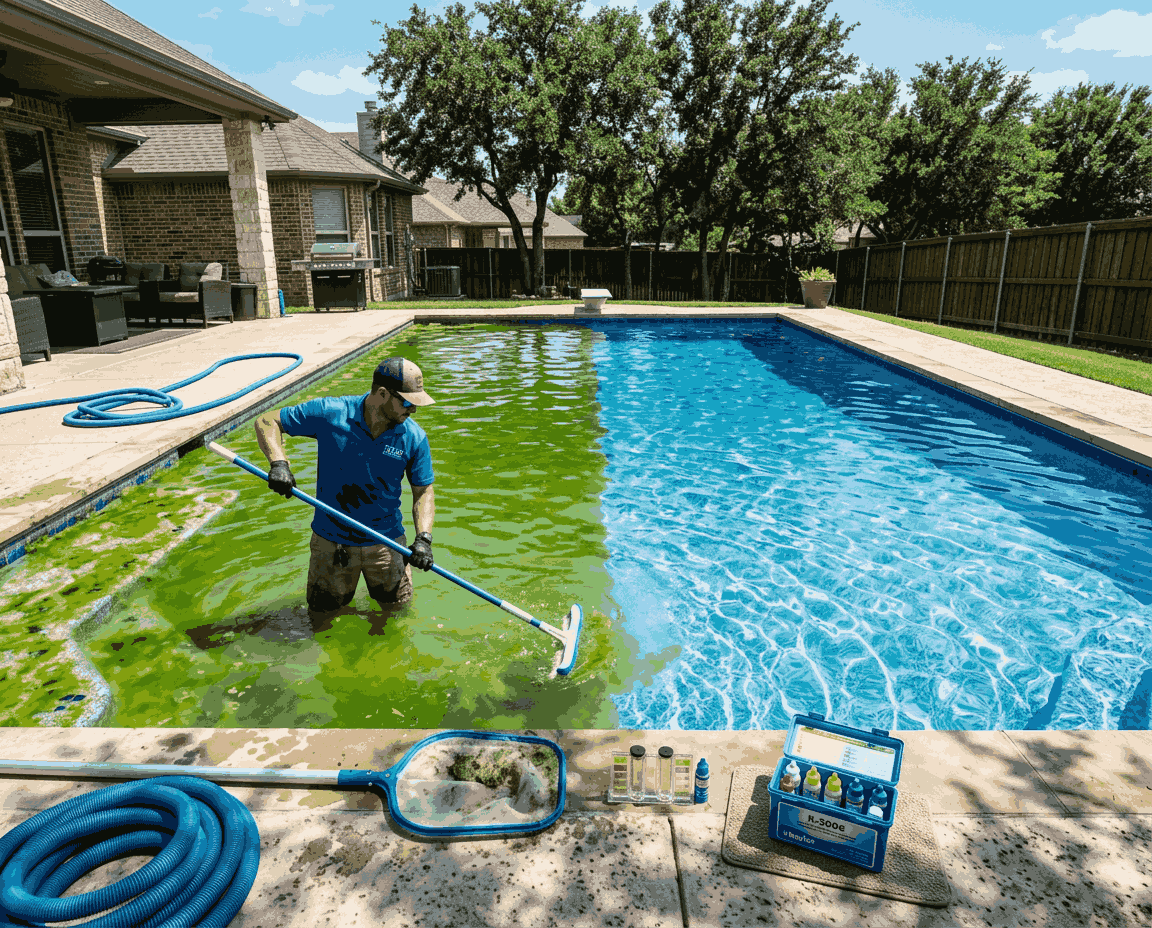
Cloudy water despite correct chemistry means insufficient filtration. Algae appearing on walls or the floor means dead spots from low circulation. Chemical levels fluctuating wildly means chemicals aren’t distributing evenly. Debris accumulating faster than the skimmer can handle means the pump isn’t pulling enough hours. If any of this sounds familiar, your pool pump run time needs to go up before you spend money on more chemicals. Our cloudy water guide and algae treatment guide cover the downstream problems that insufficient run time creates.
Freeze Event Protocol — Run the Pump Nonstop
When temps drop below 35°F in DFW, run the pump continuously. Moving water resists freezing. Stagnant water in pipes freezes and cracks them. Don’t rely on your freeze guard alone — it needs power to work, and DFW storms knock power out at the worst times. If power goes out during a freeze, immediately drain the pump, filter, and heater. Our freeze protection guide and winterization guide cover the full protocol. The National Weather Service posts freeze warnings and timing for the DFW area.
People Also Ask
How many hours should I run my pool pump in summer in Texas?
10 to 12 hours minimum. DFW summer heat accelerates chlorine loss and algae growth, requiring more circulation than cooler climates. If you have a variable speed pump, run 12 to 16 hours at low speed for even better results.
Can I run my pool pump 24/7?
You can, and during freeze events you should. For normal operation, 10 to 14 hours on a variable speed pump at low RPM gives you excellent circulation without the energy cost of running 24 hours. Running too long at high speed wastes electricity without improving water quality.
Is 6 hours enough for a pool pump in Texas?
Not during spring, summer, or fall. Six hours might work in December or January when biological activity is minimal, but from March through October your DFW pool needs 8 to 12 hours to maintain proper circulation and chemistry.
Should I run my pool pump at night or during the day?
Ideally both. Run low speed during the day for circulation and chemistry distribution while UV is hitting the water. Run higher-speed cycles at night during off-peak electricity hours. A pool automation system makes this scheduling effortless.
Does running the pool pump longer prevent algae?
Yes. Longer pool pump run time eliminates dead spots where algae grows, distributes chemicals more evenly, and keeps filtration working continuously. It’s one of the most effective algae prevention measures alongside proper chemistry.
PoolBurg Programs Your Pump for Optimal DFW Performance
Not sure if your pool pump run time is dialed in? Contact PoolBurg and we’ll optimize your schedule based on your pool’s volume, plumbing, pump type, and the season. It’s free with every service plan — and it’s one of the easiest ways to keep your pool clear year-round.