
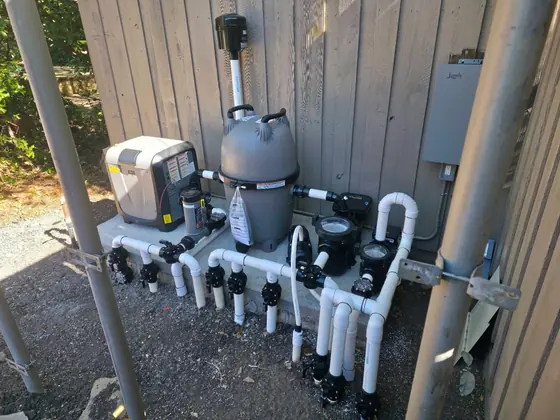
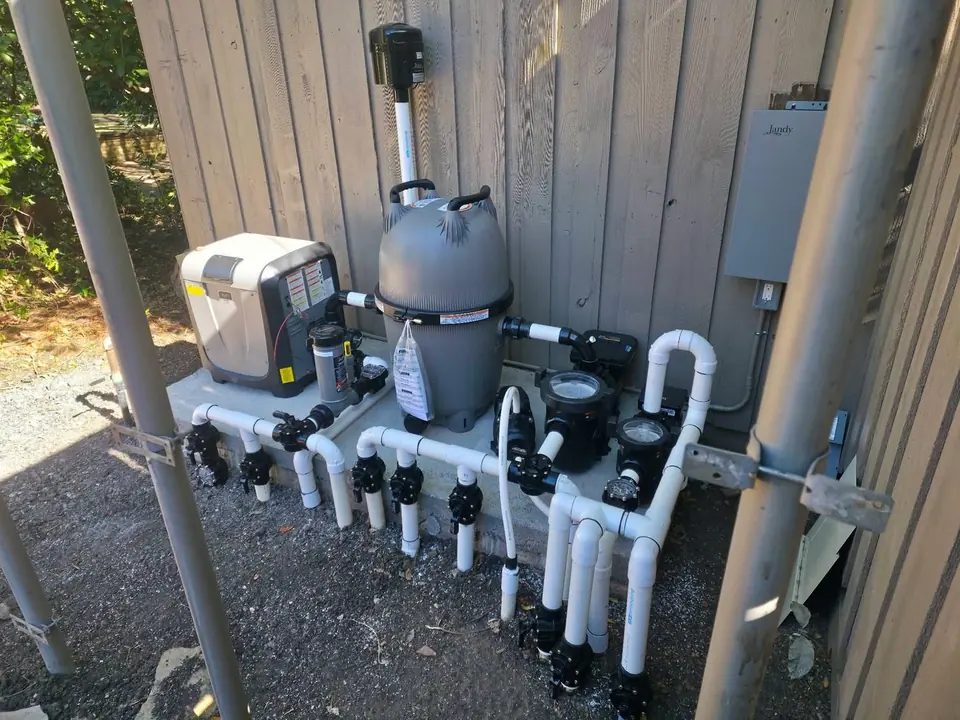
What is your pump doing?
Pick what you see. You get the likely causes, what is safe to check yourself, and when to stop.
It is loud or screaming
Most likely
- Worn motor bearings, usually after water got past the shaft seal
- The pump is starving for water and rattling
- Something is caught in the impeller
Safe to check yourself
- Are the pump basket and the skimmer baskets clear?
- Is the water level at least halfway up the skimmer opening?
Bearings do not get better. A motor that screams is on its way out, and running it can take the seal and the wiring with it.
It hums but will not start
Most likely
- A failed start capacitor
- A seized motor
- An impeller jammed with debris
Safe to check yourself
- Turn the breaker off, then see whether the motor shaft turns by hand.
Do not leave a humming motor powered. It overheats within minutes.
There is water under the pump
Most likely
- A worn shaft seal between the motor and the wet end
- A cracked housing or a bad o-ring
- A loose drain plug
Safe to check yourself
- Is the drip at the middle of the pump, where the motor meets the plastic? That is the shaft seal.
- Are both drain plugs in and snug?
A seal leak drips into the motor. Fixing the seal early is far cheaper than a motor.
It will not prime, or the basket is full of air
Most likely
- Air getting in at the pump lid or a cracked fitting on the suction side
- A low water level or a stuck skimmer flap
- A blocked line or a clogged impeller
Safe to check yourself
- Is the lid o-ring clean, greased and seated?
- Is the pool water high enough to cover the skimmer opening?
It trips the breaker
Most likely
- Water inside the motor
- A shorted motor winding
- A wiring fault or a worn breaker
Safe to check yourself
- Note whether it trips the moment it starts or after it runs a while. Tell us which.
Do not keep resetting it. A breaker that keeps tripping is doing its job.
A variable-speed pump shows an error
Most likely
- The drive overheated or lost communication with the automation
- A power problem at the pad
- A failed drive
Safe to check yourself
- Write down the exact words or code on the display.
- Turn the breaker off for a minute and back on, once.
The water flow is weak
Most likely
- A dirty filter or full baskets
- A clogged impeller
- A valve turned the wrong way
Safe to check yourself
- What does the filter pressure gauge read compared with a clean filter?
- Empty the pump basket and both skimmer baskets.
What we repair on the equipment pad
Everything between the pool and the wall it sits against.
Pumps
Single-speed and variable-speed.
- Motors, seals, bearings and impellers
- Variable-speed upgrades
- Pentair IntelliFlo, Hayward TriStar and Jandy FloPro
Filters
Cartridge, sand and DE.
- Cracked tanks and leaking valves
- High pressure and short filter runs
- Cartridge and grid replacement
Salt systems
Conversions and repairs.
- Salt cell cleaning and replacement
- Low salt and flow warnings
- New salt system installation
Plumbing and electrical
At the pad.
- Leaking valves, unions and pipes
- Valve actuators
- Timers, breakers and wiring at the equipment
Why a variable-speed pump pays for itself
Most single-speed pumps run flat out all day. A variable-speed pump runs slower for longer, and slower uses far less power.
Lower power bills
Running at low speed for filtering uses a fraction of the electricity of full speed. In a Texas summer that adds up.
Quieter
At low speed you barely hear it from the patio.
Required for new installs
Federal efficiency rules mean most replacement pool pumps are now variable-speed.
Works with automation
Set speeds for filtering, cleaning, the spa and features from your phone.
Repair or replace?
| What failed | Usually |
|---|---|
| Shaft seal leaking | Repair |
| Start capacitor | Repair |
| Bearings, on a newer motor | Repair |
| Motor, on an older single-speed pump | Replace with variable-speed |
| Cracked housing or volute | Replace the wet end or the pump |
| Variable-speed drive | Repair or replace, priced both ways |
You get both prices in writing when both make sense, and you decide.
Brands we install and repair
- Hayward
- Pentair
- Jandy
- Raypak
- Poolside Tech
We are an authorized dealer, so a new pump we install carries 3 years of warranty, registered in your name.
What happens when you book
- You bookOnline, by text or by phone. Tell us what the pump is doing.
- We find the faultThe $149 diagnostic visit tests the equipment and finds the real cause, so you are not paying for guessed parts.
- You get a written estimateRepair, replacement or both, with the price in writing before any work starts.
- We fix itWe do the work, run the system and show you it working.
Pump questions
What does it cost to find out what is wrong?
The diagnostic visit is $149. You get the cause and a written estimate, and you decide what happens next.
Should I repair my pump or replace it?
A seal, a capacitor or a set of bearings is usually worth repairing. When the motor on an older single-speed pump fails, a variable-speed pump often makes more sense. You get both prices in writing.
Why is a variable-speed pump worth it?
It runs slower for longer, which moves the same water using far less electricity and with much less noise.
Can a pump problem cause a heater error?
Yes. Low water flow is one of the most common reasons a heater shuts itself off. See the heater page.
Where do you repair pumps?
Anywhere in Dallas–Fort Worth, plus Austin and Houston.
Pump trouble? Start with the diagnostic
We test the pump, tell you what failed and what it costs to fix, and you decide what happens next.
Local teams in Dallas–Fort Worth, Austin and Houston
Teams work from Frisco, Plano, Fort Worth, Arlington, Cedar Hill, Austin and Houston, so a PoolBurg truck is never far from your pool.
 Book a visit