
In this guide
1. Complete Spa Shutdown, No Power, No Display, Nothing
The spa acts like it’s unplugged. Breaker is on, but nothing works. No display, no pumps, no heater, no lights. Everything is dead.
Common Causes Within the Control Pack:
Blown main fuse — Most control packs have a primary fuse protecting the entire system. A surge or short can blow it.
Failed transformer — The transformer converts line voltage to low voltage for the control circuit. If it fails, the board gets no power to think or display.
Burnt terminal block — The connection where power enters the pack can corrode, loosen, or burn. Power stops there.
Catastrophic board failure — A power surge, lightning strike, or water damage has destroyed the main board.
Tripped internal breaker — Some packs have a small internal breaker that can trip independently of the main breaker.
What We Do:
We start at the terminal block — is power arriving at the pack? Then we check fuses. Then we test the transformer output. Then we assess the board. We find exactly where power stops and why.
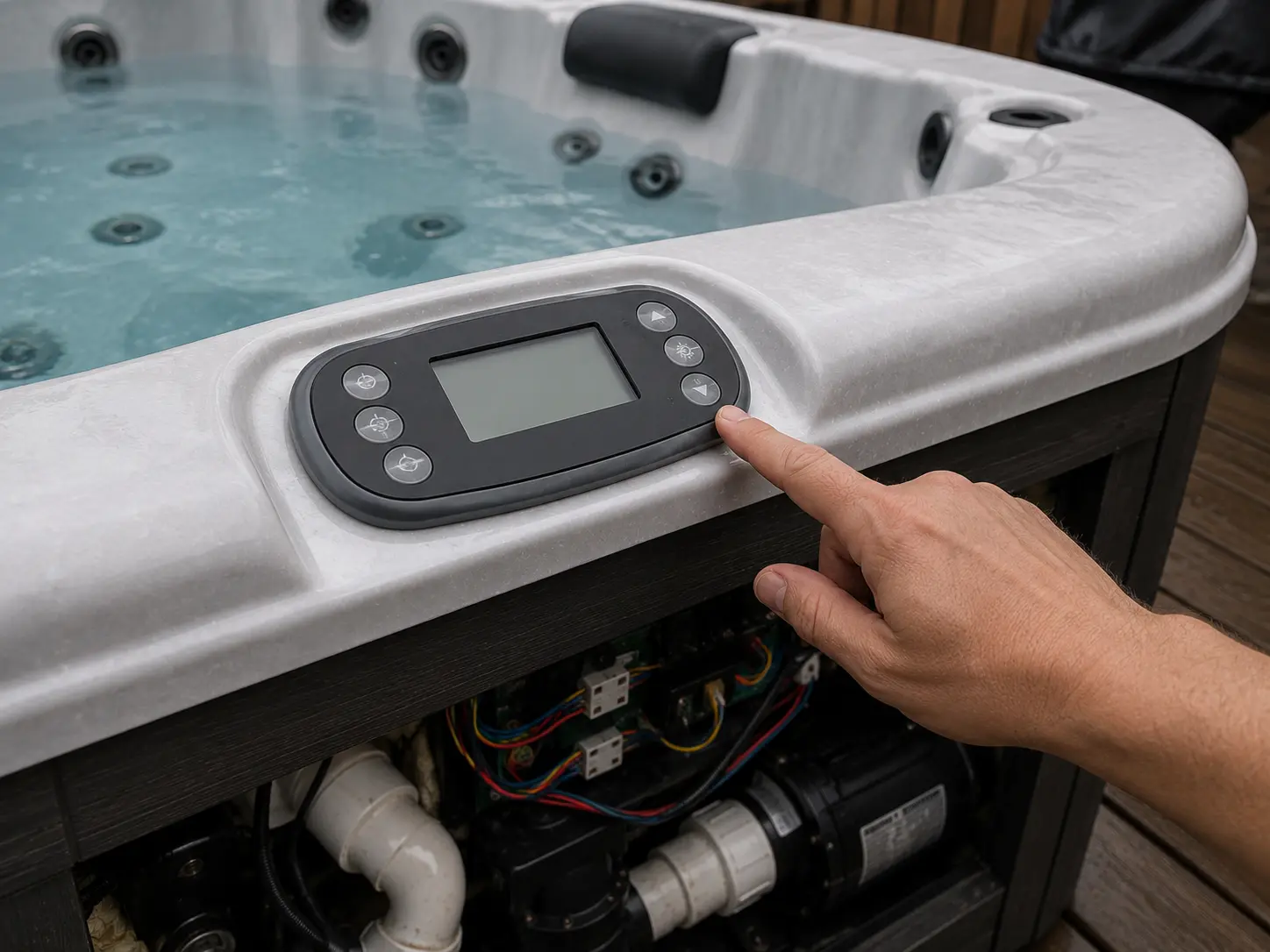
2. Breaker Trips When Spa Turns On
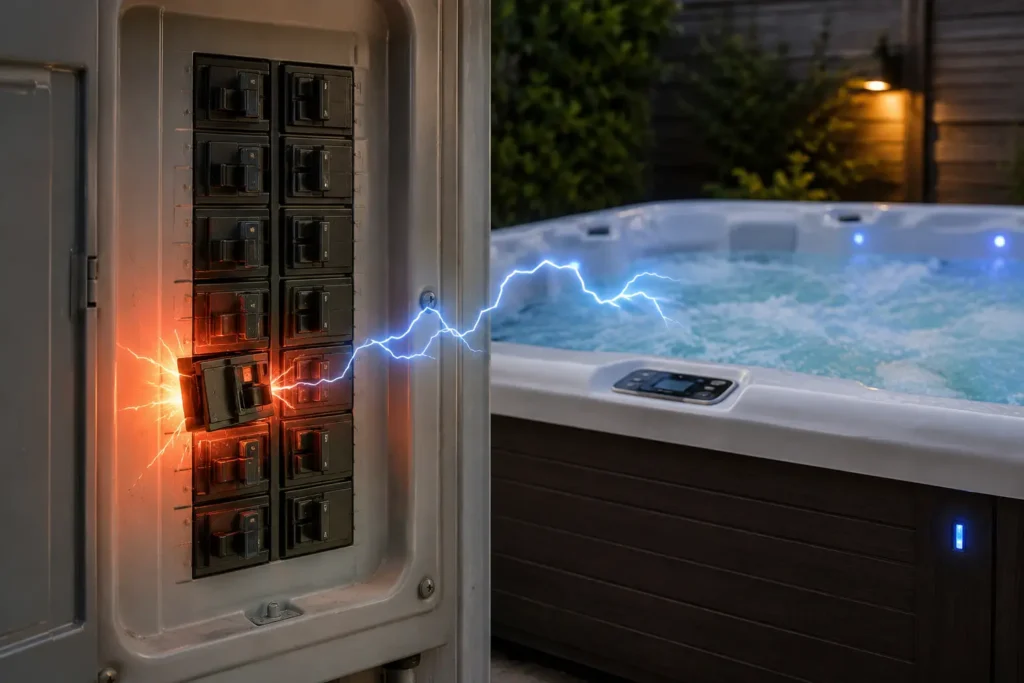
You reset the breaker, the spa starts, then the breaker trips again, sometimes immediately, sometimes when the heater or pumps kick in.
Failed heater relay stuck closed — The heater receives power the moment the spa powers up, before the flow switch can confirm water is moving. The resulting current surge trips the breaker.
Shorted component on the board — A failed capacitor, diode, or other component creates a dead short.
Carbon tracking or arc damage — Electricity has arced across a damaged area of the board, creating a conductive carbon path.
Moisture in the pack — Water or condensation inside the control pack causes short circuits.
Burnt wiring or terminal block — Damaged insulation or carbonized terminal blocks create shorts.
What We Do:
We isolate components one at a time, disconnect the heater, test, disconnect each pump, test, until we identify what’s causing the trip. If the trip continues with everything disconnected, the fault is in the pack itself. We inspect the board for visible damage, test for shorts, and determine if the pack can be repaired or needs replacement.
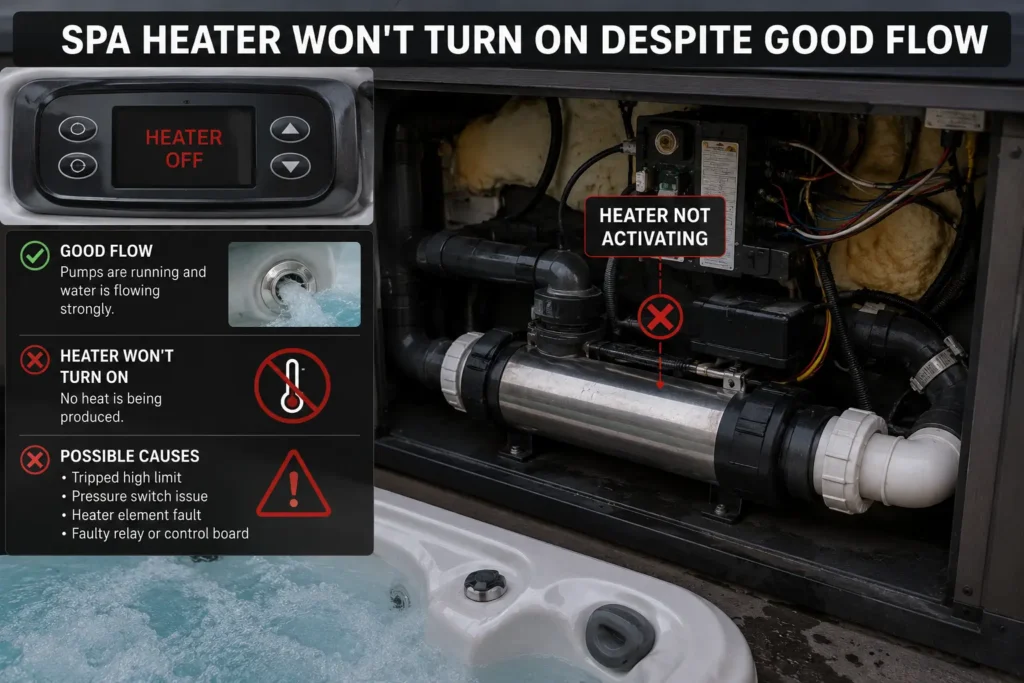
3. Heater Won't Turn On Despite Good Flow
Water is moving, the flow switch is working, but the heater never activates. The spa stays cold.
Failed heater relay — The relay that sends power to the heating element has burned contacts or a failed coil. It clicks but doesn’t pass current, or doesn’t click at all.
Burnt relay socket or board trace — The solder connections where the relay mounts to the board have failed from heat cycling.
Bad temperature sensor input circuit — The board can’t read the temperature sensor correctly, so it doesn’t know to call for heat.
Control board logic failure — The microprocessor or supporting circuitry that decides when to heat has malfunctioned.
What We Do:
We test whether the board is sending a heat call. We test whether the relay is activating. We test whether power flows through the relay contacts. We trace the fault through the pack and repair or replace what’s failed.
Pumps Won't Run or Run Constantly
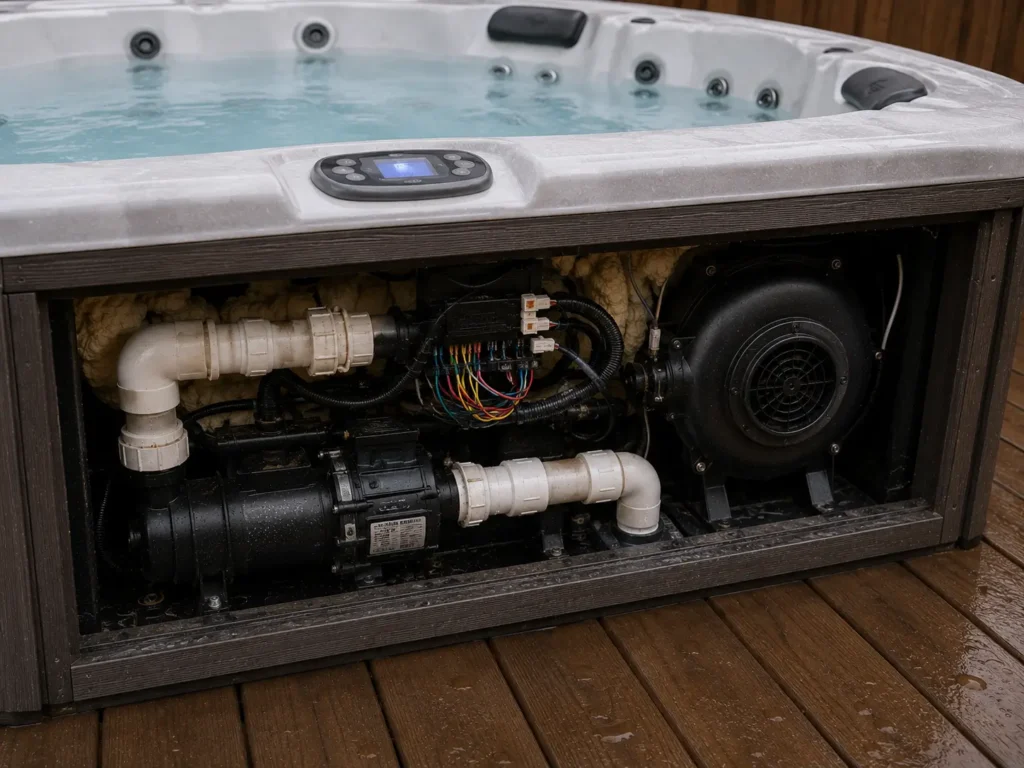
A pump that won’t start when activated, or a pump that runs continuously and won’t shut off.
Failed pump relay — Same as heater relay failure but for the pump circuit. Contacts burned, coil failed, or solder joints cracked.
Relay stuck closed — The relay contacts have welded together. The pump runs as long as the spa has power, regardless of control commands.
Blown pump fuse — Many packs have individual fuses for each pump. A pump that draws too many amps blows its fuse.
Board output failure — The circuit that sends the pump-on signal has failed.
What We Do:
We test the relay, the fuse, and the board output for the affected pump. We identify whether the problem is the pack or the pump itself (a seized pump motor can blow fuses or damage relays).
5. Topside Panel Not Responding or Displaying Errors
The topside panel shows nothing, shows garbled characters, or doesn’t respond to button presses, but the problem isn’t the panel itself.
Blown low-voltage fuse — A small glass fuse on the board protects the topside circuit.
Loose or corroded topside connector — The plug on the board where the topside cable connects is damaged.
Failed communication chip — The IC that handles data between the board and the topside panel has failed.
Transformer output low or unstable — The transformer is failing and supplying incorrect voltage to the control circuit.
What We Do:
We test voltage at the topside connector on the board. We check the data signal. We verify the transformer output. If the topside panel is good but the pack isn’t communicating with it, we find where the communication breaks down.
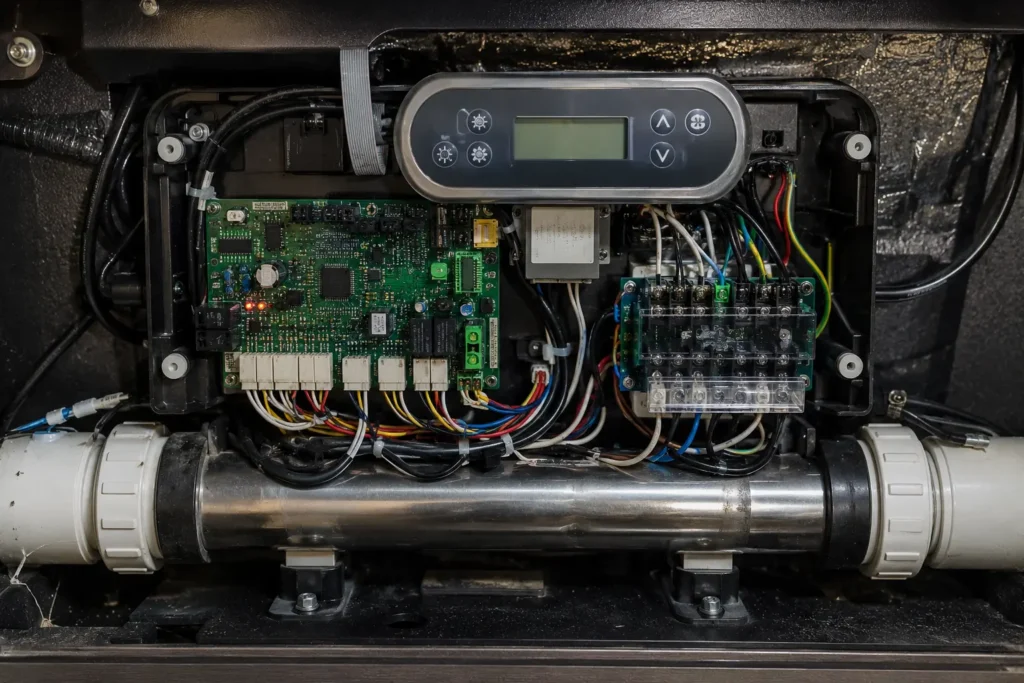
6. Random Component Behavior
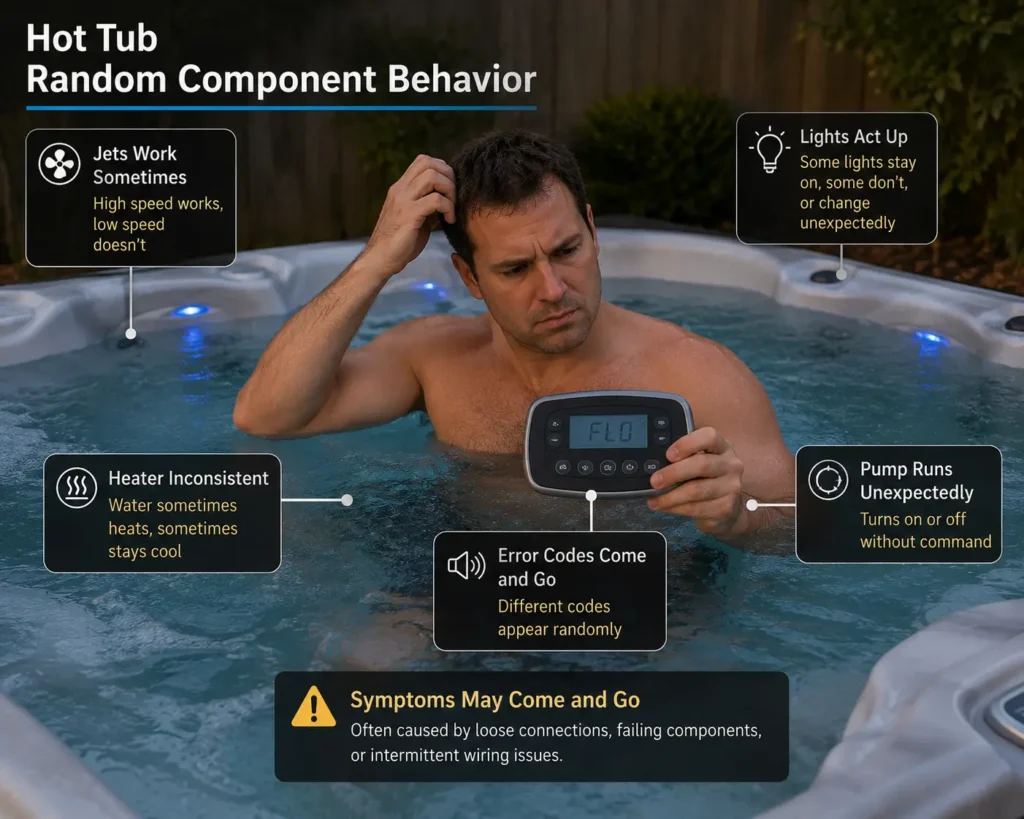
Pumps turn on by themselves. The heater cycles unpredictably. Lights flicker. The spa seems to have a mind of its own.
Corrosion on the board — Chemical fumes or moisture have corroded traces or component leads, creating partial shorts or erratic connections.
Failing capacitors — Electrolytic capacitors degrade over time and cause unstable voltage on the board.
Cracked solder joints — Temperature changes cause expansion and contraction. Cracked joints make intermittent contact.
Insect or rodent damage — Pests inside the pack have damaged wiring or left conductive debris on the board.
What We Do:
We inspect the board under magnification. We test capacitors. We look for corrosion, cracks, and contamination. Intermittent problems require patience, but they’re solvable with systematic diagnosis.
Control Pack Brands We Service
We repair and replace all major spa control pack brands:
Balboa Control Packs
The most common control system in the industry. Found in Jacuzzi, Sundance, and many other major brands.
BP Series — BP100, BP200, BP500, BP7. Workhorses of the spa world.
VS Series — VS100, VS200, VS500. Variable speed pump compatible.
GS Series — GS100, GS500. Compact packs for smaller spas.
Balboa Lite Leader — Entry-level packs.
Legacy Balboa — Older Duplex and early digital systems.
We stock common Balboa parts and can source any Balboa component.
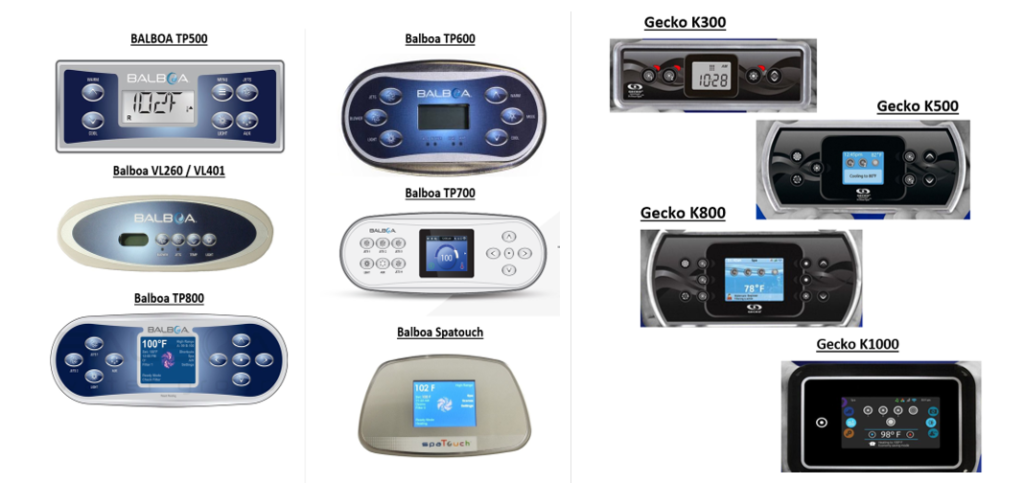
Gecko Control Packs
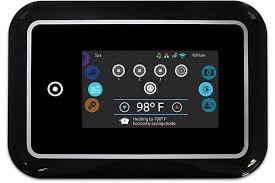
Premium control systems used in Bullfrog, Coast Spas, and many high-end manufacturers.
in.xe Series — in.xe-2, in.xe-3, in.xe-5. The current Gecko platform.
in.ye Series — in.ye-2, in.ye-3, in.ye-5. Predecessor to in.xe.
in.k Series — in.k-200, in.k-450, in.k-600. Keypad-integrated systems.
SSPA Series — Older Gecko solid-state packs.
We’re experienced with Gecko diagnostic procedures and programming.
Other Brands We Service
SpaNet / SpaNET — WiFi-connected smart control packs
ACC (Applied Computer Controls) — Used in select premium brands
Hydro-Quip — Common in many mid-range spas
Len Gordon — Older pneumatic and early digital systems
Cal Spas proprietary — Brand-specific packs
Hot Spring proprietary — Including IQ 2020 and earlier systems
Dimension One proprietary — D1-specific control packs
Repair vs. Replace: Control Pack Decisions
When Pack Repair Makes Sense
A single relay has failed and can be replaced
The transformer is bad but the board is fine
A fuse holder or terminal block needs replacement
Minor corrosion can be cleaned and sealed
The pack is relatively new and otherwise in good condition
Replacement pack is discontinued or has a long lead time
Typical repairable pack issues:
Relay replacement: $ in parts and labor vs. $$$ for a new pack
Transformer replacement: $ in parts and labor vs. $$$ for a new pack
Fuse holder or terminal repair: $ in parts and labor vs. $$$ for a new pack
When Pack Replacement Makes Sense
Multiple components have failed simultaneously
The board has extensive corrosion, burn damage, or carbon tracking
Lightning or major surge damage is widespread
The pack is obsolete and repair parts aren’t available
Repair costs approach 60-70% of replacement cost
You want modern features your old pack doesn’t support (WiFi, variable-speed pumps, etc.)
Benefits of new pack replacement:
Full manufacturer warranty
Updated safety features
Often more energy efficient
May support modern accessories
No lingering concerns about other aging components
Our Control Pack Diagnostic Process
1
Symptom Documentation
We listen carefully to what the spa is doing, and not doing. Error codes, sounds, patterns, when it started. Details matter.
2
Visual Inspection
We open the equipment bay and examine the control pack. Burn marks? Corrosion? Loose wires? Water intrusion? Pests? Many problems are visible.
3
Incoming Power Verification
We test voltage at the terminal block. Correct voltage? Both legs present? No voltage drop under load? Problems here aren't pack problems.
4
Fuse & Protection Check
We test every fuse in the pack. We check internal breakers. A blown fuse often points to a problem downstream that needs to be found.
5
Transformer & Low-Voltage Testing
We test transformer input and output. Low voltage powers the brains of the pack. If it's wrong, nothing works right.
6
Relay Testing
We test each relay, does it activate when called? Do the contacts pass current? Are the solder joints intact?
7
Component Isolation
We disconnect external components one at a time to isolate faults. Does the breaker hold with the heater disconnected? Do the pumps run normally one at a time?
8
Board-Level Diagnosis
For board-level faults, we use magnification, multimeter testing, and thermal imaging when needed to find failed components, cracked joints, and damaged traces.
9
Clear Quote
We tell you exactly what's wrong, what repair or replacement options exist, and what each costs. You make an informed decision.
10
Repair & Full System Test
We complete the repair or replacement, reconnect everything, and run the spa through every mode. Heat, jets, blower, lights, all functions verified.
Why Choose Poolburg for Control Pack Repair
All brands, all ages
Current production smart packs to 30-year-old pneumatic systems. We work on them all.
Correct diagnosis
We find the actual fault. We don't replace a control pack because a connected component is bad. We don't chase symptoms while the cause gets worse.
Dallas, Fort Worth, and every city in betweens
Authorized warranty center
Repairs meet manufacturer standards for all major brands
Brands We Service
We repair all major portable hot tub brands. If you don't see yours listed, call us, we likely service it.
Frequently Asked Questions
How do I know if the problem is the control pack or something else?
You don’t, not without testing. That’s what we do. A spa that won’t heat could be the heater element, the flow switch, the temperature sensor, or the heater relay in the control pack. A pump that won’t run could be the pump motor, the capacitor, the wiring, or the pump relay in the pack. We isolate components and test systematically to find the actual fault rather than guessing.
Can a pooCan a control pack be repaired, or do they always need replacement?l pump be repaired instead of replaced?
Many control pack problems are repairable. Individual relays, transformers, fuses, and terminal blocks can be replaced. Corrosion can often be cleaned. Cracked solder joints can be resoldered. Not every problem requires a new pack. We repair what’s repairable and replace what isn’t — and we tell you honestly which path makes more sense.
How much does a new control pack cost?
Control pack prices range from a few hundred dollars for basic universal packs to over a thousand for premium OEM packs. Installation labor is additional. The total cost depends on your spa’s brand, age, and the specific pack required. We give you a clear quote with options, repair the existing pack, replace with OEM, or retrofit with a compatible alternative.
Can you upgrade my old control pack to add modern features?
Yes. If your old pack is failing or you want modern features, a retrofit pack can add WiFi connectivity, app control, variable-speed pump support, and more efficient heating control. We can recommend a retrofit pack that works with your existing pumps, heater, and topside panel, or include a new topside if needed.
How long does control pack replacement take?
Most control pack replacements are completed in a single visit — typically 2 to 4 hours depending on the complexity of your spa and whether any wiring adaptations are needed. Retrofit installations on older spas may take longer if significant rewiring is required. We’ll give you a time estimate with your quote.
My spa keeps blowing the same fuse. Can I just use a bigger fuse?
Never. Fuses are sized to protect the wiring and components they serve. Installing a larger fuse defeats that protection and can cause wiring to overheat, components to fail catastrophically, or even start a fire. A fuse that blows repeatedly is telling you there’s a real problem. We find and fix the cause rather than bypassing the safety device.
Let Poolburg Take care of your Spa.
Spa control pack acting up? Call Poolburg for expert diagnosis and repair across DFW.
 Book a visit